
🕒 8 min read
Published April 17, 2026
Fairycore “Dewdrop Nails” Are the Viral Spring Manicure Trend Taking Over 2026

In the quiet hush of early spring, when the first light catches on blades of grass still heavy with overnight moisture, a new manicure has emerged that feels less like polish and more like captured nature itself. Dewdrop nails have slipped into the collective imagination of beauty circles worldwide, their translucent 3D gel droplets perched atop sheer, jelly-like bases that echo the fragile shimmer of morning dew. This is no fleeting TikTok experiment. By April 2026, the look has moved from niche Instagram Reels into the hands of fashion insiders, influencers, and everyday wearers who crave something whimsical yet refined.
What sets dewdrop nails apart is their deliberate fragility. Nail artists sculpt tiny, rounded domes of clear or tinted gel that catch the light exactly as real dew would, creating an illusion so convincing that the hand appears freshly plucked from a fairy-tale meadow. The trend draws directly from fairycore aesthetics—the same romantic, nature-obsessed movement that once revived cottagecore and goblincore but now feels more polished, more intentional. Where earlier iterations leaned heavily into glitter and pastels, 2026’s fairycore nails favor restraint: a misty blue base here, a whisper of sage green there, all finished with the kind of glass-like shine that makes the droplets look perpetually wet.
The appeal is immediate and visceral. In an era still recovering from years of digital fatigue, these nails offer a tangible escape. They are not loud. They do not scream for attention. Instead, they invite close inspection, rewarding the viewer who leans in to admire the way light refracts through each 3D gel droplet. Spring nail art 2026 has found its perfect muse in this ethereal manicure, one that feels both nostalgic and forward-thinking.
The Making of a Dewdrop: Technique Meets Fantasy
The technical backbone of dewdrop nails lies in 3D gel nails mastery. Unlike traditional embellishments that sit flat on the nail plate, these droplets are built up in layers of builder gel or thick top coat, cured between applications to create genuine dimension. Artists begin with a sheer jelly base—think translucent pinks or barely-there blues that allow the natural nail to peek through—then strategically place the domes using a fine dotting tool or even a micro-spatula. The secret is asymmetry. Real dew never falls in perfect rows; it clusters, it drips, it lingers on curves. That organic placement is what separates amateur attempts from salon-level work.
Many technicians are now borrowing from Japanese nuance nails, a philosophy that prioritizes subtlety over statement. Rather than covering every nail in identical droplets, they might place three on the ring finger, one solitary dome on the index, and leave the thumb almost bare except for a faint chrome glaze that catches the light like wet stone. The result feels handcrafted rather than manufactured, which is precisely why it resonates so deeply in 2026.
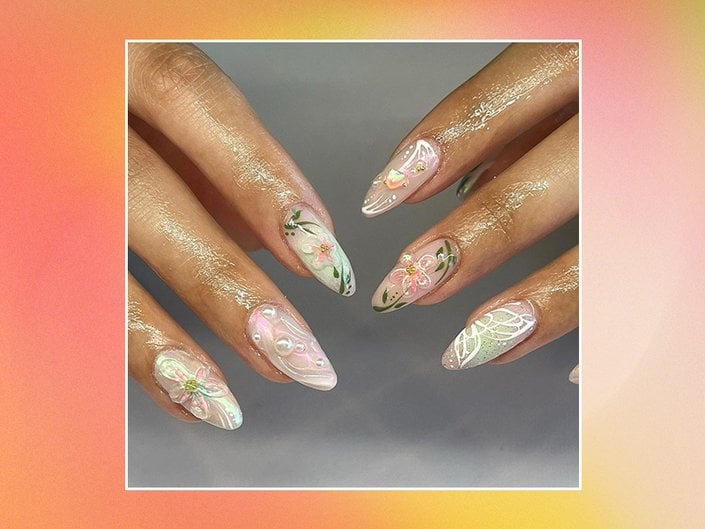
Cat-eye finishes add another layer of magic. A magnetic pigment is dragged beneath the jelly base before the 3D elements are added, creating a soft vertical shimmer that shifts as the hand moves. Chrome glazes, applied sparingly over the droplets themselves, give the dew an almost metallic edge without losing translucency. Watercolor blends—achieved by dragging diluted gel polish with a fine brush—complete the ethereal effect, turning each nail into a miniature landscape of mist and petal.
These techniques are not new in isolation, but their combination is. The 3D gel nails trend has existed in various forms for years, yet paired with fairycore’s garden-fairy narrative and spring’s natural palette, it has found fresh life. The droplets do not merely decorate; they narrate. They suggest a wearer who paused on a woodland path long enough for the world to leave its gentle mark.
Color Stories That Define the Season
The 2026 palette for dewdrop nails is deliberately soft, almost hesitant. Misty blue dominates, evoking the pale sky just after rain. Lavender follows closely, not the harsh purple of past seasons but a bruised, powdery shade that feels like twilight filtered through wisteria. Sage green appears frequently, sometimes as the base, sometimes as a watercolor wash beneath the droplets, nodding to the tender new growth of early spring. Soft yellow—barely more than buttercream—surfaces in accent nails, catching the eye like dandelion clocks in a meadow.
:max_bytes(150000):strip_icc()/springmanis_recirc-d08aae053d014448b6482854ea190ab7.jpg)
These hues work because they are inherently forgiving. Jelly textures amplify their depth, allowing light to travel through the nail rather than bounce off it. When paired with chrome glaze nails, the colors take on an otherworldly iridescence that shifts from cool to warm depending on the angle. The effect is never garish. It is, instead, quietly luxurious—a manicure that flatters every skin tone precisely because it refuses to compete with it.
Nail artists report that clients arrive asking not for “something pretty” but for “something that feels like spring rain.” The request itself reveals how deeply the trend has embedded itself in the cultural mood. After seasons of bold chrome and maximalist embellishment, the pendulum has swung toward delicacy. Dewdrop nails satisfy that craving without sacrificing modernity.
Fairycore Nails and the Broader Cultural Shift
Fairycore nails did not appear in a vacuum. They emerged from a larger conversation about escapism, sustainability, and the quiet rebellion against digital perfection. Where once beauty trends chased impossible gloss and uniformity, 2026 favors imperfection—deliberate, romantic imperfection. The same impulse that sent fashion toward unstructured linen and unhemmed hems has found its manicure counterpart in droplets that look as though they might evaporate at any moment.

On TikTok and Instagram, the hashtag ecosystem tells the story. Clips of dewdrop nails set to lo-fi folk or the gentle rustle of rain have racked up millions of views. Creators film their hands brushing through actual dewy grass, the real droplets mirroring the gel ones in a moment of uncanny symmetry. The trend’s virality owes much to its shareability: it photographs beautifully in natural light, requires no filter, and invites storytelling. “Woke up like this—literally,” one caption read beneath a close-up of lavender nails glistening with fresh 3D gel.
Yet the deeper current is emotional. Fairycore aesthetics tap into a collective longing for wonder. In uncertain times, a manicure that evokes childhood stories of hidden realms offers more than decoration. It offers permission to dream. Garden fairy nails, with their sculptural florals and glass-like shine, extend that invitation further, blurring the line between body and landscape.
Sculptural Details and Japanese Nuance Techniques
The most sophisticated expressions of the trend incorporate elements that feel almost architectural. Sculptural florals—tiny, raised petals formed from colored gel—nestle beside the dewdrops, creating miniature ecosystems on the nail plate. Some artists embed micro-crystals or iridescent flakes within the droplets themselves, so that each one sparkles like trapped morning light.

Japanese nuance nails techniques have proven especially influential here. The approach emphasizes negative space and intentional imperfection. A single droplet on an otherwise bare nail can feel more impactful than a full coverage design. This restraint elevates the entire aesthetic, preventing it from tipping into costume. The result is wearable fantasy—something you can take into a boardroom or a wildflower field without explanation.
From Viral Feeds to Real-World Wear
The jump from screen to salon has been swift. By mid-March 2026, appointment books at high-end nail studios in New York, London, and Tokyo were filled with requests for “the dewdrop thing.” Nail technicians trained in 3D gel nails suddenly found themselves fielding questions about fairycore references they had never heard before. The trend’s accessibility helped: while elaborate versions require a skilled hand, simpler iterations can be achieved at home with builder gel kits and patience.

Celebrity adoption—subtle but noticeable—has added quiet credibility. Actresses spotted at Paris events with misty blue tips, models backstage at fashion week displaying sage green droplets under flash photography. None announced the trend; they simply wore it. In the age of algorithmic discovery, that organic spread matters more than any press release.
How to Achieve the Look—And Why It Endures
Recreating dewdrop nails at home begins with preparation. A strong base coat, a sheer jelly polish in one of the season’s signature shades, and a high-quality builder gel are non-negotiable. Cure thoroughly between layers. Place droplets with a dotting tool, varying size and placement for realism. A final chrome glaze or cat-eye magnet pull adds dimension without overwhelming the delicacy.

The endurance of this trend lies in its adaptability. As spring gives way to summer, the same droplets can be reimagined on warmer bases or paired with fresh floral accents. Come autumn, they might shrink and cluster like early frost. The core idea—capturing nature’s fleeting beauty—transcends season. In 2026, dewdrop nails have reminded us that the most powerful trends are not imposed from above but grown from the ground up, one translucent droplet at a time.

They ask us to slow down, to notice light and texture and the small miracles that happen every morning in the grass. In a world that moves too fast, that feels like luxury enough.


