🕒 5 min read
Published April 20, 2026 · Updated April 28, 2026
Dario Vitale’s Bold Vision for Versace – How the First Non-Family Creative Director Is Reshaping Italian Glamour in 2026
The appointment of a non-family creative director at Versace has always carried symbolic weight, but in 2026 it becomes something more deliberate: a recalibration of legacy. The house, long defined by the gravitational pull of the Versace name itself, now moves under the direction of Dario Vitale. The phrase “Dario Vitale Versace 2026” has quickly evolved from industry speculation into a defining reference point for contemporary Italian fashion.
What makes this moment notable is not simply the shift in authorship, but the tension it creates between continuity and revision. Versace has never been subtle in its language—its codes are maximal, sensual, and rooted in a visual confidence that resists dilution. Yet the current era demands reinterpretation rather than repetition. Within that space, Dario Vitale Versace 2026 becomes less about replacement and more about negotiation: how far a house can evolve before it risks losing its recognisable pulse.
Across Milan’s creative circles, the conversation is less about whether change was necessary and more about how it is being executed. The early signals suggest a designer intent on precision rather than disruption for its own sake. The question now is whether restraint can exist inside a brand historically built on excess.
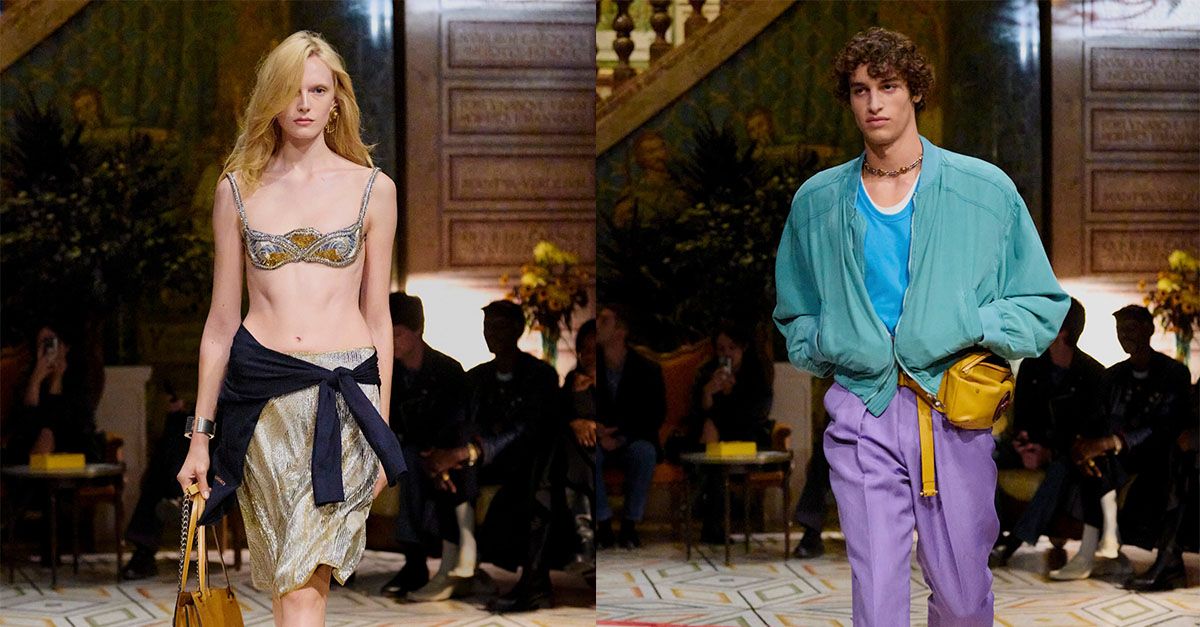
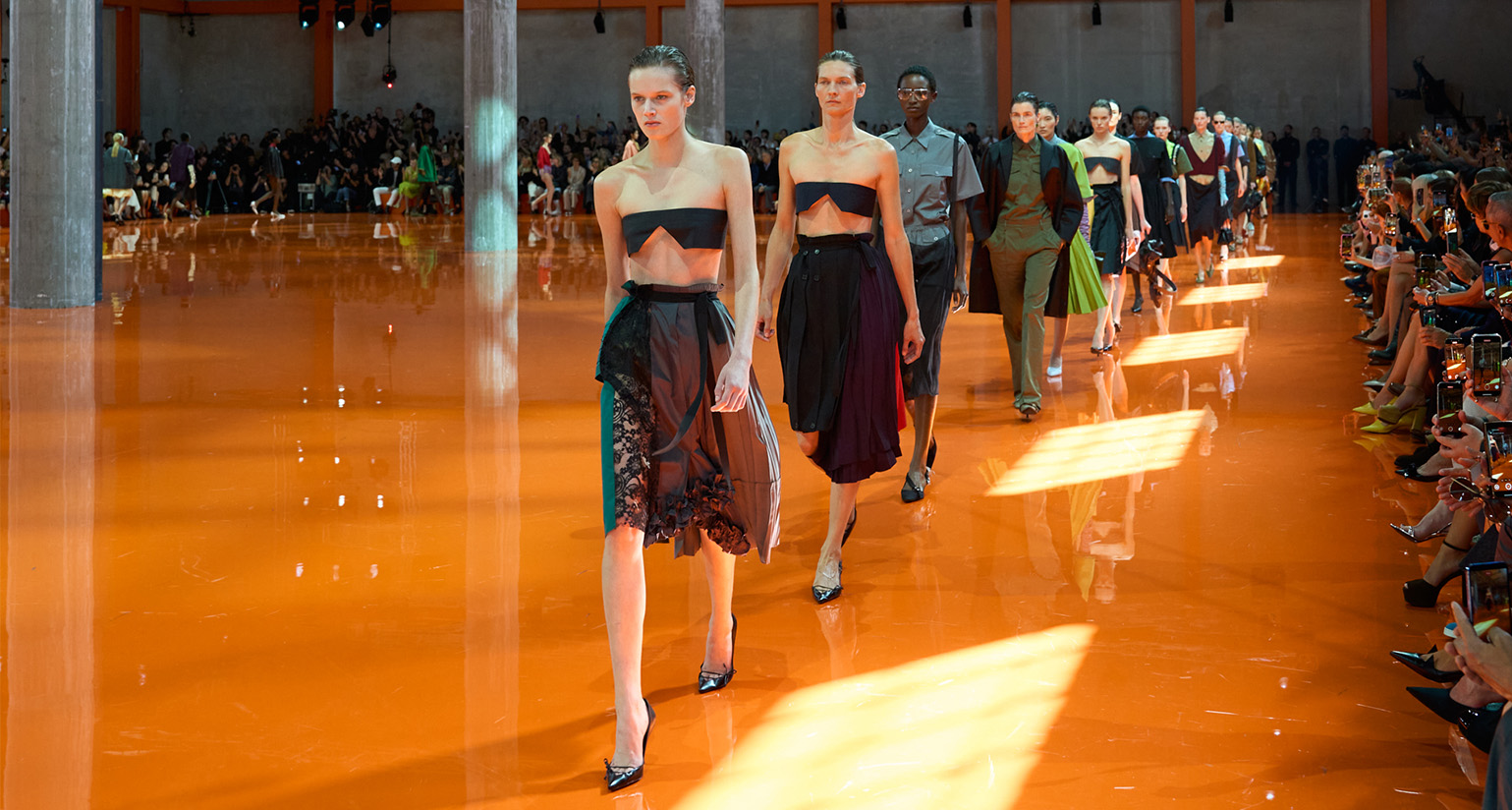
Image: Versace Spring 2026 runway looks by Dario Vitale – models walking in structured yet sensual silhouettes during the Milan show.
A SHIFT IN AUTHORSHIP WITHOUT ERASING IDENTITY
Versace’s archive is not a neutral reference point—it is an active presence. Medusa emblems, baroque ornamentation, and hyper-sensual tailoring have defined the house for decades. What distinguishes this new direction is the decision to treat these elements not as static symbols but as material for reinterpretation.
In early readings of the collection, silhouettes appear controlled but not diminished. Shoulders are sharpened, proportions reconsidered, and familiar motifs re-scaled rather than removed. The result is not a rejection of heritage, but a recalibration of its volume.
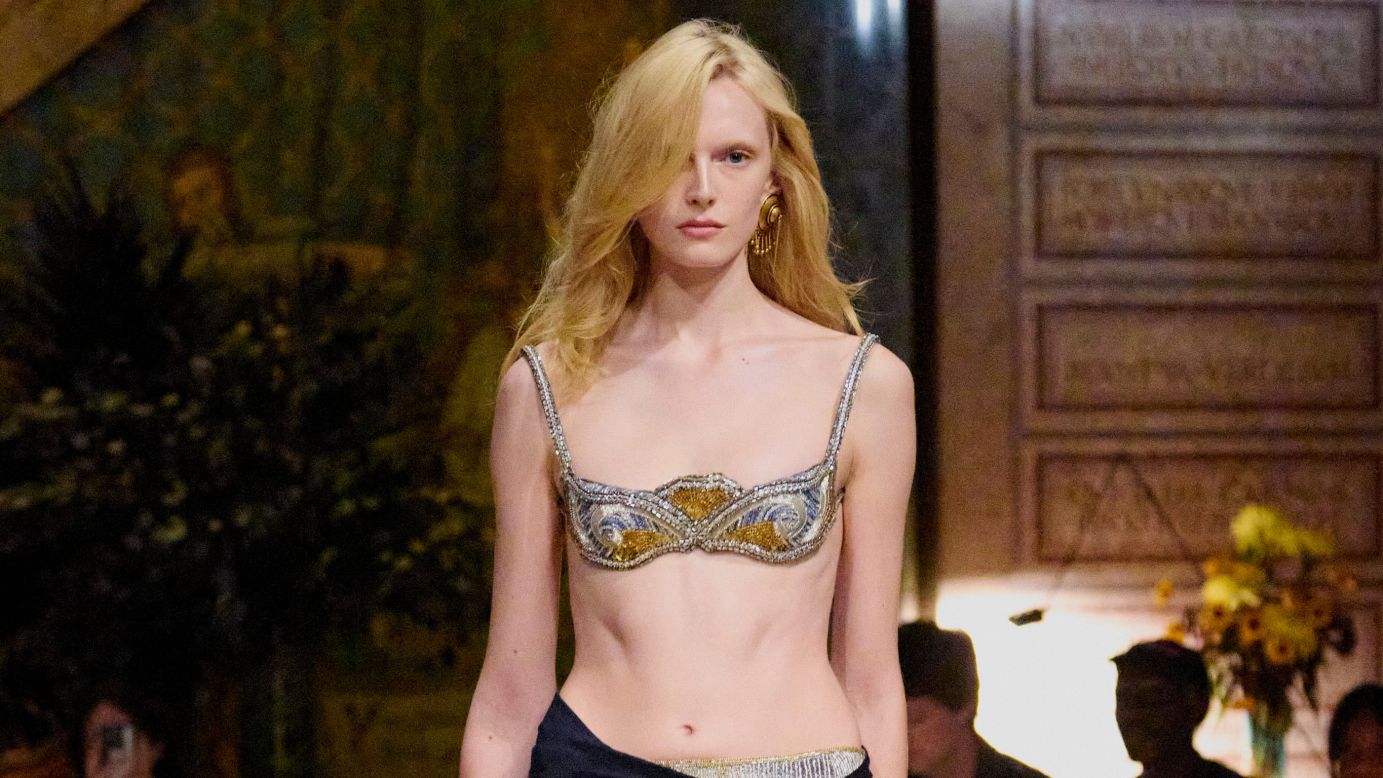
Image: Close-up detail of reworked Medusa-inspired metallic and embroidered motif on a Versace 2026 top by Dario Vitale.
This is where the tension becomes visible. The house is no longer speaking in pure declaration; it is speaking in edits. That shift is subtle, but in luxury fashion, subtlety often signals the most significant structural change.
THE NEW ARCHITECTURE OF ITALIAN GLAMOUR
Italian glamour has always been a language of presence. In this collection cycle, it is increasingly expressed through structure rather than ornament alone. Tailoring carries weight, but it is interrupted by fluidity—draped elements that soften the rigidity of cut without dissolving it.
Within this framework, the evolution of Dario Vitale Versace 2026 becomes a study in controlled contradiction. The garments are neither minimal nor maximal; they operate in a space between definition and suggestion. It is a recalibration of glamour that feels designed for contemporary visibility—less about spectacle in isolation, more about movement within real environments.
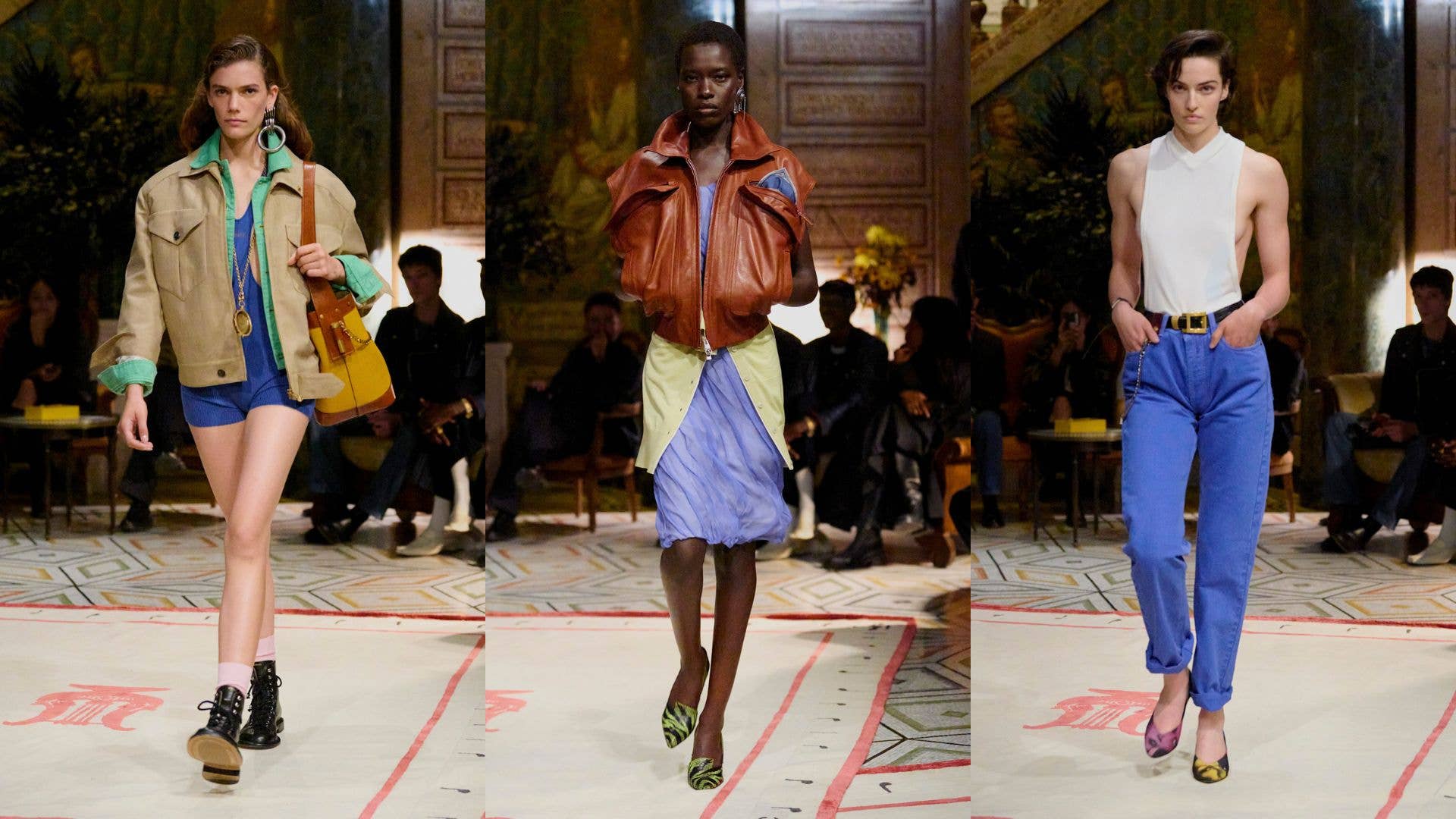
Image: Full-length Versace 2026 look featuring a structured jacket layered with fluid, draped elements – a perfect example of controlled contradiction.
The industry has seen a broader return to disciplined silhouettes this season, particularly across Milan and Paris. Yet Versace’s interpretation resists the neutrality that often accompanies restraint. Even when reduced, the language remains expressive.
ACCESSORIES, COLOUR, AND THE REWRITE OF SIGNATURE CODES
Accessories have historically functioned as amplifiers within the house’s visual system. In this new direction, they take on a different role: punctuation rather than escalation. Oversized jewellery is still present, but it is positioned with more intention, less saturation.
Colour, meanwhile, operates as architecture. Instead of overwhelming the eye, it defines structure. Blocks of saturated tone are used to construct rhythm across the silhouette, creating a sense of visual segmentation that feels more editorial than theatrical.
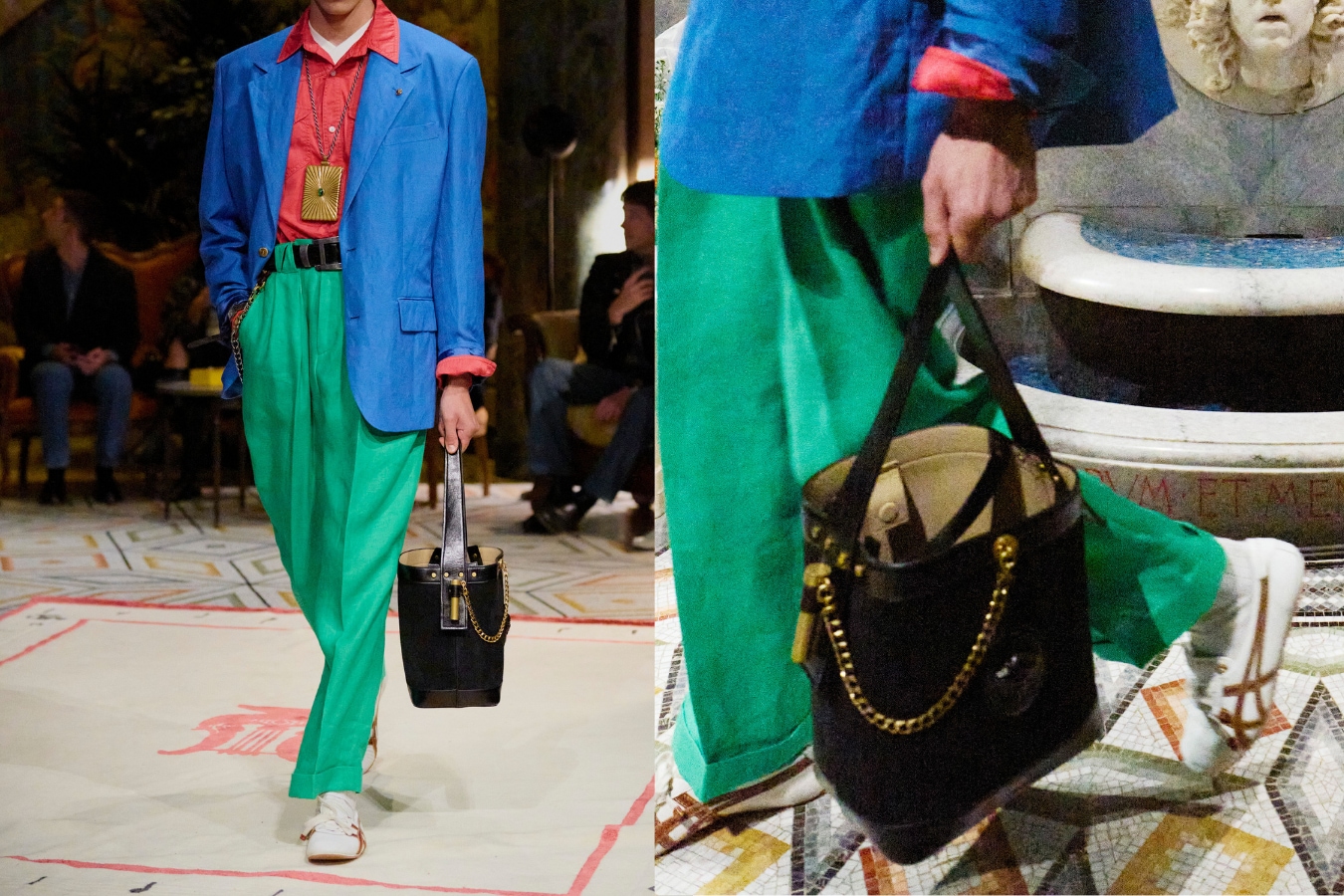
Image: Bold color-block Versace 2026 ensemble with strong accessories, showcasing the new disciplined yet impactful approach.
This is where the collection reveals its most strategic thinking. Versace does not abandon its instinct for impact—it reorganises it. The effect is not quieter, but more disciplined.
INDUSTRY RESPONSE AND THE QUESTION OF OUTSIDER LEADERSHIP
The appointment itself continues to resonate beyond the collection. Heritage houses have historically oscillated between internal continuity and external disruption, but rarely with this level of scrutiny attached to the outcome.
Dario Vitale Versace 2026 has become a case study in how outsider leadership is absorbed by legacy systems. Early responses from the industry suggest cautious approval: the collection is being read as commercially viable while still retaining runway authority, a balance that is increasingly difficult to achieve.

Image: Backstage / runway atmosphere from the Versace Spring 2026 show by Dario Vitale – models in structured garments.
What remains unresolved is longevity. The first season establishes tone; the following seasons determine structure. The real question is not whether the vision works now, but whether it can sustain coherence under commercial and cultural pressure.
THE FUTURE OF A HOUSE IN TRANSITION
Versace has always been defined by its ability to occupy extremes without collapsing into them. The current evolution suggests a recalibration of that instinct rather than its removal. The house is still expressive, still assertive—but the mechanism of expression is being refined.
In this context, Dario Vitale Versace 2026 operates as both a marker and a test. It defines a moment of transition while simultaneously exposing the fragility of that transition. The balance between legacy and authorship remains delicate, and its resolution is far from complete.